As this New Year started, I noticed that my passion has been doused with cold water and is currently not as fully alive as it once was. It's been a month since I went to both meetings and I come back that it seems that the plan of SA2020 and SA Tomorrow 2040 really feel all talk and no action. Meanwhile, the people who sit on the BMAC are currently trying to get San Antonio to the goal of #VisionZero.
Now Normally I would be writing an entire blog on what happen, but not this time, today, you'll have to hear about what happened. This is my first attempt at podcasting, so please give me a pass, it was recorded while I was at work.
Now in the podcast, I will be mentioning about the TIP, also known as the Transportation Improvement Program. And there will be several meetings taking place soon, so it's important that you get to at least one of these meetings and send in comments. As you go through the list of projects (download spreadsheet here) make sure you tell them that no protected bicycle lane, then no project. The projects that I recommend are the following.
Project #29:
Loop 368 (Broadway) Complete Street (Reduces Road Capacity)
A TxDOT project from US 281 Interchange to Mulberry. Construct separated bicycle and pedestrian facilities between US 281 and Cunningham and intersection improvements between Cunningham and Mulberry.
Project #41:
MyLink Pedestrian Connectivity/ Safety
A VIA project on the various State roadway system around San Antonio. Construct curb ramps, landing pads, sidewalks and other pedestrian infrastructure and construct improvements to North Star Transit Center intersection for improved transit access.
Project #10:
Citywide San Antonio Pedestrian and Bicycle Improvements
A City of San Antonio Project to Construct citywide pedestrian and bicycle projects to enhance safety (Z-crossings, medians, surface, signage)
About a day or two ago, I got a lengthy message on my Facebook page from a fellow cyclist who complained about how nothing is getting done. He posted his complaints on the Bicycle Collective Meeting photo which I posted on my Facebook page back in September 2015.
Quote:"I
went to such a meeting and got nothing for my efforts. It was at the
Via metro center on San Pedro. All the officials listened but gave no
plan of action to address my concerns, What a waste of time."
He goes on to say quote: "Every
month the San Antonio Event Center hosts the gun show. The attendees
park in the bike lanes. The additional traffic from the event make bike
riding very difficult. The event center has a huge parking lot but the
attendees choose to park in the street
instead of paying the $3 fee to park. The main problem is on Meadow
way. I called my Council person ,Ray Lopez and spoke to the president of
the Meadow Village Neighborhood association but got no positive
response."
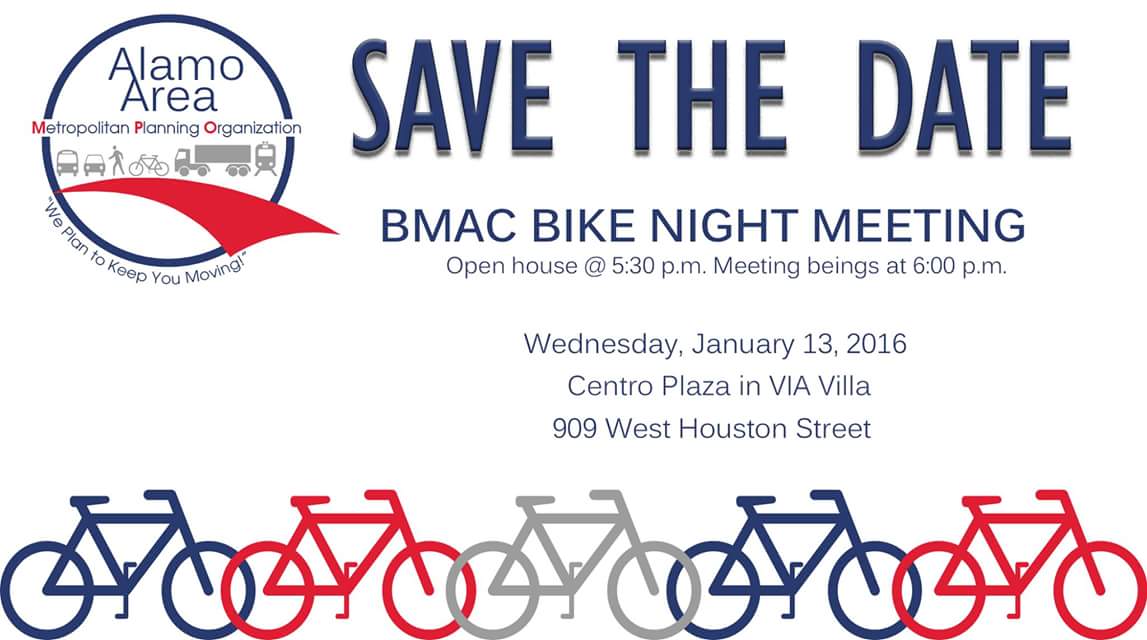
Now he didn't attend the Bicycle Collective meeting, he attended one of the BMAC Bike Nights which happen 3 times a year. BMAC, The Bicycle Mobility Advisory Committee meet every second Wednesday at 8AM at the Alamo Area Planning Organization, 825 S St Mary's St, across from Rosario's. All meeting are open to the public, so if you are unable to attend their bike nights, you can try to attend their morning meetings.
After reading his complaints, I got a notification of one of the three annual BMAC Bike Night meetings taking place on Wednesday, January 13, 2016, this time at the Westside Multimodal Center. Also that night, SA2020 is holding their own meeting called "Realizing the Dream of a World-Class City: Driving Action in San Antonio" which is going to be held at the Pearl Stables. Now since I already spent the money to attend the SA2020 meeting, I guess I'm going there, sorry BMAC.
Now sorry for sounding like a conspiracy nut, but why are both meetings taking place on the same night? Wouldn't the people at SA2020 want the people who sit on the BMAC to be present and give their input? Even though the person who sent me the message about the SA2020 meeting asking to get lots of cyclist to come to the SA2020 event, wouldn't it be better to have the people who already advocate for cycling be at SA2020 meeting? It sounds like they don't want anyone who rides a bicycle for transportation to come. Now I'm certain there are legitimate reasons why they just happen to be taking place on the same night and at the same time, but it sounds like they want to keep the cyclist away and focus on what I think Ron Nirenberg wants his plan, SA Tomorrow 2040 to be focus on, alleviating traffic congestion for which I precluded to what SA Tomorrow 2040 was about in the first place back in September 2014.
Now this is why you need to attend these meeting, because if you're not heard, you're complaints and concerns are not taken into consideration. Representative Government don't work if you don't go out and vote and attend local government meetings on things you're interested in and effect you. But the question is which one? Just remember the BMAC meeting is free and open to the public while the SA2020 meeting cost $15.
I like to wish everyone a happy new year. In April, it will be two years since I started to write about San Antonio lack of building good bicycle infrastructure and not really having good public transportation even though they operate it pretty well.
Speaking about public transportation, my job keeps me away from San Antonio for months on end and I do enjoy it. When I have time off, I get out and explore the community that I am stuck in. Naturally I get on my bicycle and ride around and use the local transit at the same time.
48-1
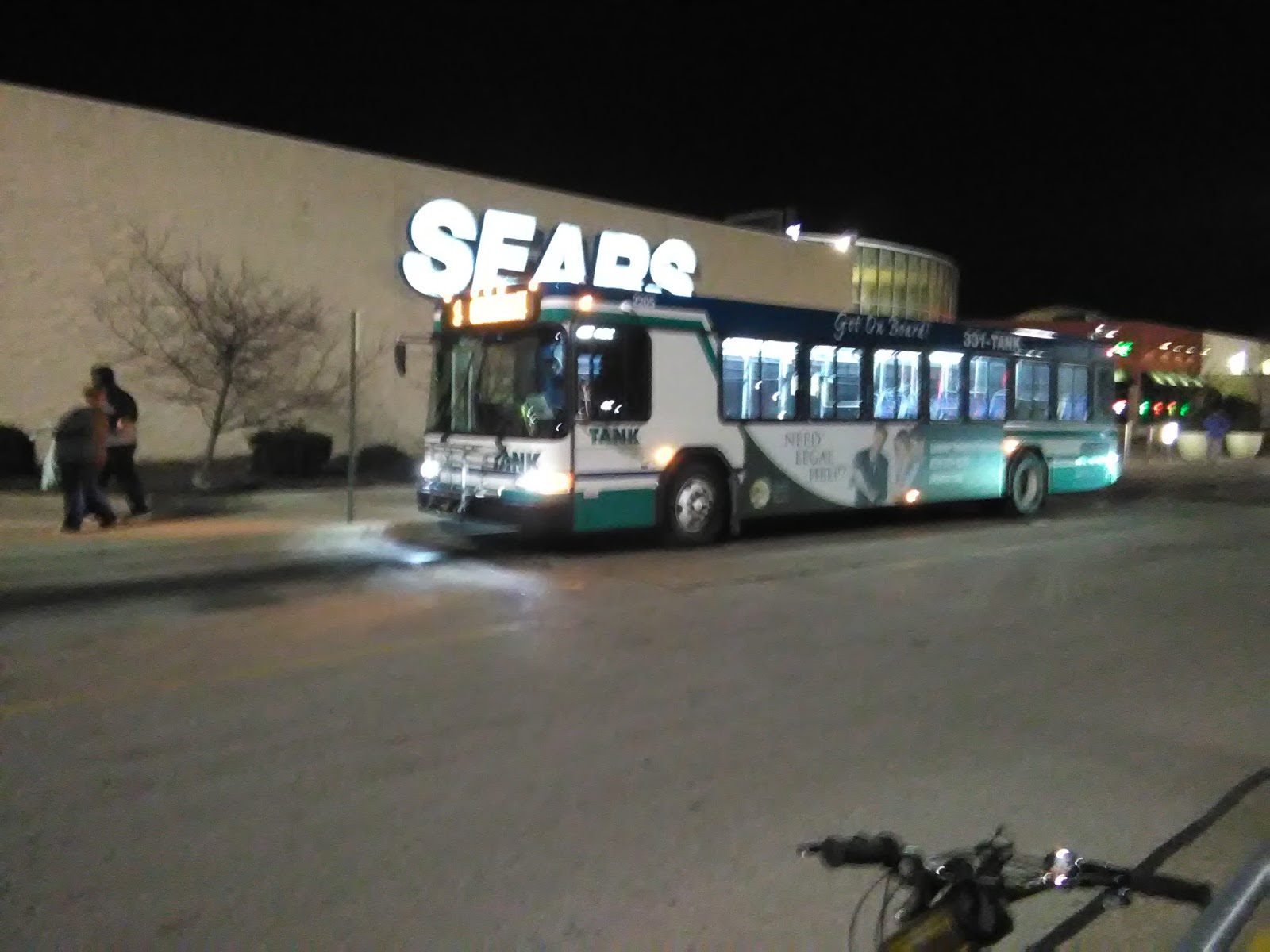
Here’s a question, why don't VIA have their buses stop at the entrance to the Mall? It seems that in every place I go to, the local transit buses stop at the entrance to the Malls. Now for the record, DART, The T, and the DCTA also don't stop at the entrance to Malls. It seems to be a Texas thing.
Every other place I go to, the transit system have the bus stop right at the front door to suburban mall. There's no walking across the vast parking lot, there's no walking almost 1/4th mile from the bus stop to the entrance in 110°F heat or heavy downpour. It's getting off the bus and walking roughly 50ft from the bus to the Mall entrance.
I don't really know the reason why this happens here in Texas, but it just does and it seems to be an antiquated thing really. In all my years of riding VIA, the bus got close like at Westlakes Mall and even actually stopped at the entrance to Central Park Mall. For a time, it stopped at the entrance to Crossroads, now Wonderland. So the next time you end up speaking to a VIA bus official, ask them why can our buses stop at the entrances to our malls here in San Antonio. And yes, Rivercenter don't count.
Also I noticed that in some cities, the bus stopped at the entrance to grocery stores. The closest thing VIA has are stops in Walmart parking lots.
Image:
48-1: A Transportation Authority Of Northern Kentucky (TANK) route 1 stopping at the entrance to Sears at the Florence Mall in Florence, Kentucky, a suburb of Cincinnati, Ohio.
With being active and working long hours, I rarely have time to catch up on the news. So it's sad that I came across this story from the Rivard Report only now that was written back in February. I forgot who shared it on Facebook or who tweeted it, but I read it and I can't believe that I missed such news on La Villita.
According to the commentary quote:
"All reports concluded that re-imagining the retail mix and the quality
of goods and services, improving infrastructure, programming public
spaces, and better marketing were equally necessary. In short, La
Villita is a historic treasure, but much is needed to bring it up to
21st century retail standards. We agree."
So the problem seems to be that not enough people are coming in. It's walkable, it's quaint an such a nice place, so why aren't people coming in? The answer to that isn't because there's no coffee shop with wifi, it is because there's no people living there. Now I'm not saying destroy a few historic buildings and build a apartment complex, I'm saying that no body lives there and we're currently treating it like a suburban mall. So like every other suburban malls, it has a bunch of vacancies and eventually even the kiddos stop hanging out and the mall closes. You can point to the success of North Star and Wonderland, but those are the exceptions, not the rule.
47-1
As you look on Google Maps, (Image 47-1) you see an area surrounded by parking lots, those dead areas where we store our motor vehicles. This is why they're referred to as Parking Craters by advocates like me, because they're a blight on the urban landscape. This is one of the main reasons why people aren't going there. It's because it is so far away from where they live and there's these wide stroads surrounding it such as S Alamo. As long as we have this undeveloped spaces being used as blighted storage areas called parking lots, the problems will continue with the historic downtown and downtown viability as a whole. Because if you don't live there, you have no real vested interest in the place. If an opportunity arises, we should look into having housing inside the historic La Villita. Parking Lots are simply areas with no activities what so ever. This is why they're referred to as "Parking Craters."
Now some of you will say, hey, didn't you say La Villita Should be a model for the redevelopment for Hemisfair? And that I did, but it wasn't about how La Villita was being treated, it was how there's no cars there. There's a reason why I'm so against cars and that's because cars have more rights than you or I do when we're walking or riding our bicycles. I don't know how many times I've heard getting hit by a car and the driver just driving off and just getting a slap of the wrist. And if you don't believe me, Freakanomics did an episode on how to get away with murder, and it was about how you can kill with your car and get away with it.
When we built towns, we use to build them like La Villita, small places where everyone could get to where they were going by walking. We're now coming back to this original design as we rebuild Hemisfair and redevelop areas in the inner city. La Villita has a heads start in being walkable because the streets are too narrow for motor vehicles. As the development continues in Hemisfair, we'll see a bleeding effect from people calling Hemisfair home. Now we don't have to destroy anything in La Villita, but we should work on making housing opportunities available with in the historic neighborhood and around it especially in those parking craters.
Images: 47-1: A Google Satellite Map image of La villita and the surrounding area.
I would like to admit that I was wrong about something. In my post Streetcar IV: The Future of Rail in SA, mentioned that if any rail transit would be built in San Antonio, it would be along the rail line that parallels I-10 on the northwest side. Well it looks to be that I was wrong, for now there's talk about actually building the Austin/San Antonio Commuter Rail and the city council approved the money for the project back in August.
46-1
Now don't get me wrong, I'm all for this project and whatever the outcome may be, I will be using it and encouraging everyone else to use it if only to encourage people to see what a proper protected bike lane should look like. In the end, it's not like it's going to be a great success. Now I'm going to put this in a two part series. In this blog post, I'll be focusing on the train operations.
46-2
If you ever rode the DART light rail in Dallas, or any of the other rail transit systems in the DFW area, you would know by now that this train takes about 45 minutes to get from the end of the line to downtown. It takes the Trinity Railway Express about an hour to get from Downtown Fort Worth to Dallas Union Station. The train makes stops at all the station along the route. To ride this train, you have to buy a ticket to ride from one of many tickets machines at the station. If you happen to board the train without a ticket, you'll most likely encounter a fare enforcement officer of DART and if you fail to produce a ticket, you'll either get a $150 fine or a warning which I received after failing to produce a day pass I purchased earlier on a DART bus. This same situation also is on the Red Line in Austin.
Now when I was in Chicago, I rode the Metra Electric District train. I purchased my ticket from a ticket machine as I've always done when I went to other cities, but I didn't have to. For as I just finished purchasing my ticket, I almost missed the train. It's a good thing that the conductor saw me and open the door to allow me to get aboard. As I was riding the train to Millennium Park, I came to discover that I could have purchased my ticket from the conductor on-board the train. For the record, the conductor's official title on-board the Metra Electric District is Trainman.
46-3
Now this train doesn't stop at every single stop along the way. Several stops are bypassed and can be requested when informing the Trainman that you want to stop there. If you happen to be at one of the stations which the Metra Electric District bypass, there's a light you can turn on to signal the train that you want to board.
46-4
The PBS News Hour recently did a story on the DART light rail system in which they mentioned the fact that more people ride the light rail in Houston compared to Dallas, yet Dallas has more miles of track. The reason that the story gave was that Houston's Metro light rail system is built where people already go compared to Dallas DART system which is built along old railroad tracks. The Metra Electric District is also build along a railroad R.O.W., it was built back in the 19th century built along an active class one railroad, Canadian National.
So here's a question, if the goal is to get people to ditch their cars in choice of transit, why can't DART, DCTA, the Trinity Railway Express (TRE), CapMetro, and now The Lone Star Rail District, (LStar) the name for the Austin/San Antonio Commuter Rail, do what they do on the Metra Electric District? The way we plan for transit here in Texas seems to go against the reason on why we all drive cars. The way we operate all the rail transit service including the way we're going to operate the LStar, is by having the train stop at every station. This is akin to driving your car along the freeway and stopping at all the gas stations along the way from origin to your destination.
46-5
We punish everyone who fails to buy a ticket either on their smart phone or at a station. Instead of punishing the people who are unable to buy tickets early on, why don't we give them a chance to buy them on the train with a small surcharge fee so they're more likely to use the system again especially if they're running late.
If we're going to operate the LStar the same way the TRE, and every other transit system in Texas operates it's trains, I can say with certainty that only one percent of commuters between Austin and San Antonio will ever use it. If we fail to plan for express trains between Austin and San Antonio, driving will still be the preferred choice. If we make it hard for first timers to use the train, we simply make it harder for other people to choose it. We have a chance to not repeat the mistakes that every other system in Texas has done. We can either learn from their mistakes or keep on doing the same thing over and over again expecting a different result; the very definition of Insanity.
If you wish to comment on the future LStar, you can click here. Don't be afraid to leave a link to this blog post.
Images:
46-1: The DCTA Commuter Train at Downtown Denton Station.
46-2: The Metra Electric District Train at Homewood Station.
46-3: A Lady hurrying off the Train while The Trainman stands watch at Homewood Station
46-4: DART Light Rail Blue Line Arriving at Garland Station
46-5: TRE Arriving at Fort Worth ITC Station.
Some good news is coming to VIA. Apparently Rey Saldaña’s short dependency on VIA convince him that things needed improvement. So he is proposing that the Advance Transportation District funds that are dedicated to the City, be given to VIA to improve bus service. It's an awesome plan because one of the main reasons why VIA SUCKS, despite being an incredible system, is that they only receive 1/2 cent sales tax.
45-1
For those who aren't familiar with the Advance Transportation District, (ATD) it was voted on back in 2004 to raise the sales tax 1/8 cent sales tax for transportation improvements. Half of the 1/8th cent tax goes to VIA while the other have is further divided between the City of San Antonio and TxDot. Rey Saldaña’s plan is to take the City's portion of this sales tax and give it entirely to VIA to help pay for more bus service.
Now for the record, I'm all for this, with VIA having more money to spend, they can increase the frequency of some of their routes and even speed up the process of buying new buses. But despite the improved service, there's a simple flaw, you're going to have more empty buses.
You see there's a reason why service sucks for the people of District 4, and that is because when you have empty buses in the first place, the people in charge tend to either remove those resources entirely or put those resources into other ares. Now just because Saldaña wants to improved the frequency of some bus routes doesn't mean that more people are going to ride the bus, it means that those like myself who depend on VIA, we're going to get more options and less time at the bus stop.
There are many reasons why people don't ride the bus. I mention those reasons last year when I wrote about the Streetcar project. It is a simple fact that the majority of San Antonio gets around by car and no matter how much you increase that service, those people aren't going to choose to ride the bus. I have met people who cannot comprehend getting around San Antonio without a car and when they lose that car, they basically become prisoners in their own home. I cannot understand why such a person would choose to remain a prisoner despite having some type of bus service that would help them get access to the wider world. Now this happens all the time and it's been my experience that this refusal to use VIA seems to be with the majority of San Antonio when they become car less.
The main reason why public transit bus service pretty much sucks throughout North America is because we get empty buses. Despite what you might hear about buses being superior to rail because it's "Flexible." Well always remember that the bus's flexibility is also the biggest weakness to buses for buses are so flexible, that they can be removed from service tomorrow. And that what pretty much happens across the country. When buses start carrying less and less people, the politicians and the naysayers against public transit start pointing out how a waste of money it is to operate all those empty buses and thus the service starts to dwindle. At first, its just one or two buses removed from a 30 minute frequency to every hour. Because the service is less reliable, fewer people ride it, thus more service is cut and it becomes an endless spiral to where there's less and less service to in the end, there's none.
And That is my fear, we're for a short time are going to get improved service, but when that improvement isn't being utilized by the general public, it will eventually be cut. And that is something I don't want to happen. There's a reason why I call Transit Dependent people like myself Hostage Users, it is because we're a hostage to the decisions of people who drive cars and those people for the most part, don't think of the consequences when they remove bus service because of that service having empty buses.
If Rey Saldaña and the rest of the city council can allow to have empty buses for the next ten years, then I'm all for giving the city's share of the ATD to VIA. But if he and the rest of the City council wants more people to ride the bus, well I suggest that he makes the bus fare free for the residence and make the tourist and others who are not residences of San Antonio pay for their bus rides. I wrote about this on how we could improve VIA especially providing free bus rides for the citizens of San Antonio for it was number 6 on my list.
45-2
Now in Gilbert Garcia's Story in the Express News (Image 45-1) mentions that there's some city staffer's who are resistant to Rey Saldaña’s idea and that's because the city lacks funding to pay for roads and sidewalks. The reason why we have such a shortfall of funding is because we don't utilize our tax base efficiently enough. If you want to understand this more, I recommend that you take an hour of your time and watch the presentation of Joe Minicozzi at the Strong Towns Memphis Boot Camp (Video Above) for he'll explain why cities across the nation has such a shortfall in providing for transportation and other civic services we all take for granted.
The latest Useless bicycle lane is now open. Has been open for almost a month now and you can use this latest uselessness on Arsenal along the HEB headquarters. (Image 43-1)
43-1
To understand why this was built, you're going to have to listen to a awesome podcast called 99% Invisible, episode name Arsenal of Exclusion. It talks about how infrastructure can be used to funnel and control human behavior. In the case of this useless protected bicycle lane, it is used to encourage people on bicycle to not ride down S Flores, but to choose S Main instead and connect with the protected bicycle lane that was build behind the new grocery store.
In the end, by not putting it down on S Flores, the people who live in the new apartments along S Flores will choose to drive to the new HEB grocery store instead of doing the environmental thing to do which is to ride your bicycle or walk. If you don't think that putting bicycle lanes where they're not needed don't have an effect on the rest of us, just look up into the sky, we're not in compliance anymore.
Now it's not completely useless after all, it provides space for joggers and people walking who live in the King William area. Only time will tell if this useless bicycle lane becomes a parking lane during fiesta. Then the rubber barriers will be destroyed and thus the joggers will loose out on their new jogging strip.
In the Netherlands and Denmark, they don't put protected bicycle lanes down streets like Arsenal, instead they lower the speed limit to about 20 mph. The Author of Copenhagenize.com, came out with a chart on where to put bicycle lanes. It clearly shows in kilometers per hour on where to put the bicycle lanes. (Image 43-2) By using this chart, it clearly shows that a street like Arsenal don't need a protected bicycle lane, speed limit is just too low.